
The premium is real. Branded residences do sell for more than comparable unbranded property, and the figure is large enough that it deserves to be examined rather than believed.
What follows is not an argument against branded residences. It is the set of questions we would want answered before paying the premium, because the premium is paid on the day of purchase and the value behind it is delivered, or not, over the following ten or twenty years.
Savills Branded Residences Report 2025/26
The size of the thing
Branded residential schemes worldwide, as at the end of 2025.
910
▲ 19% in a year
Completed schemes globally, up from 764 in December 2024
1,747
by 2032
Total once the 837 contracted projects in the pipeline complete
+33%
average premium
Price premium over comparable non branded property, globally
+55%
Asia Pacific, five years
Growth driven by Vietnam, Thailand and India
Savills Branded Residences Report 2025/26, published November 2025. Dubai leads the world with 64 completed schemes and 87 in the pipeline, ahead of South Florida on 48 and 55, and New York on 32 completed. The 33% figure is a global average across all price points and locations, not a number any individual project can promise.
Phuket has its own version of that number
Locally the pattern holds at a slightly lower level. Branded condominiums on the island were achieving around ฿181,000 per square metre against a market median of ฿144,000, a premium of 28 percent, in supply data current as at April 2025.
So an owner is looking at roughly a quarter to a third more per square metre. On a substantial residence that is a significant sum, and the honest question is not whether the brand is prestigious. It is what the brand is contractually obliged to do in exchange.
The premium is paid in one afternoon at a notary. The service it bought has to turn up every morning for twenty years.
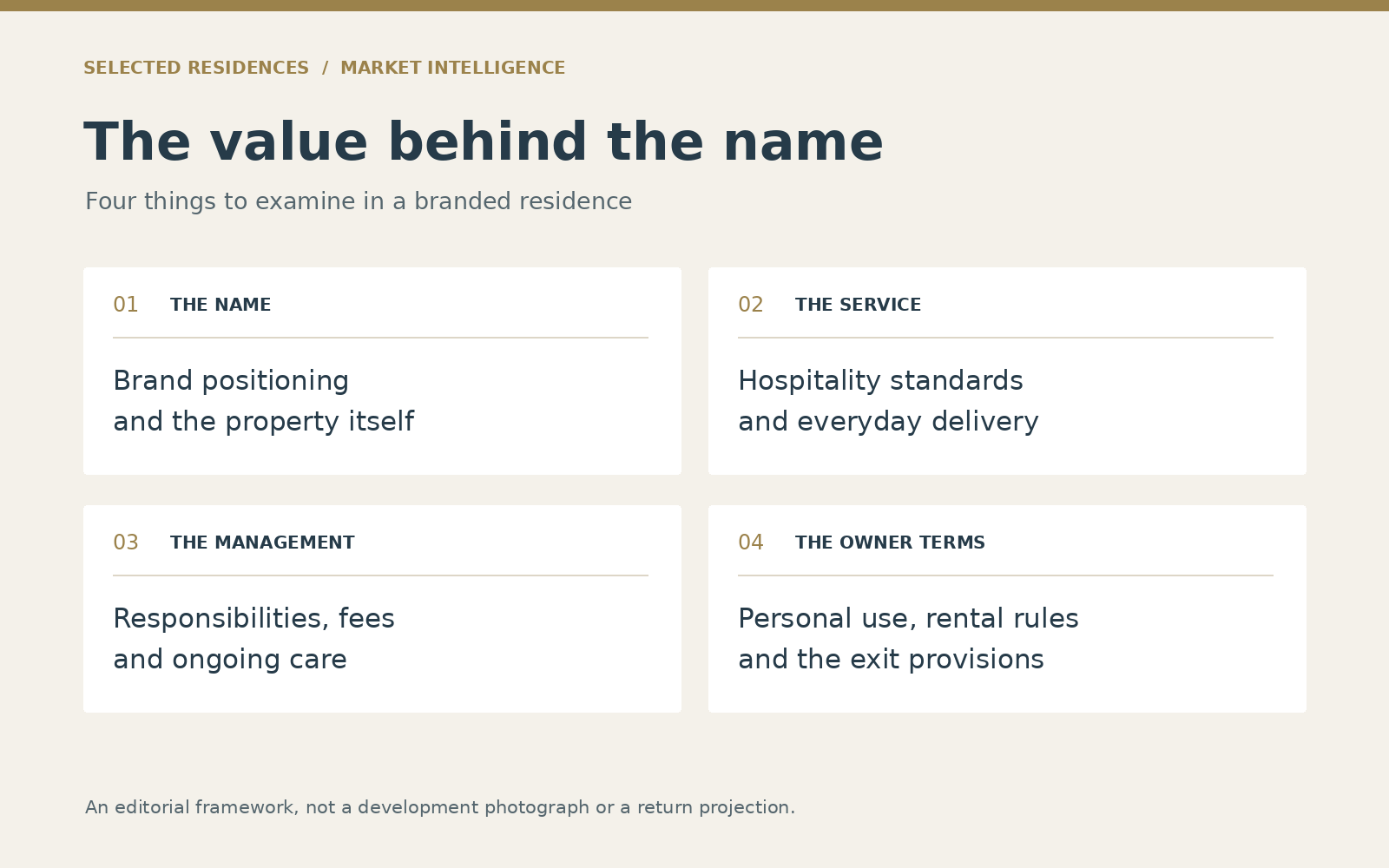
Four clauses that decide whether the premium was worth it
Read these before the brochure. In our experience they are where the difference between an excellent branded scheme and a disappointing one actually lives, and they are almost never discussed at the point of sale.
01 The licence term, and what happens at the end of it
A brand is licensed to a scheme for a fixed period. The premium was paid on the assumption that the name stays on the building. Ask how long the licence runs, what the renewal mechanism is, who decides, and what the building is called if the brand walks away.
This is the single largest hidden variable in branded residential. A scheme that loses its brand in year twelve does not become a bad building, but it does become an unbranded building that was bought at a branded price.
02 The rental programme, and who controls the calendar
Some schemes require the residence to be placed in the operator’s rental programme. Some make it optional. Some make it optional in the contract and impractical in reality, because the building services are structured around the programme.
The questions that matter: is participation mandatory, is revenue pooled across units or attributed to yours, who sets the rate, and can you decline a booking? Pooled revenue is not inherently worse than attributed revenue, but the two produce very different outcomes for a well located unit in a mixed building.
03 The owner use clause
This is the one that surprises people. In many branded schemes the number of nights an owner may occupy their own residence is capped, the dates may need to be requested in advance, and high season may be restricted or excluded outright.
If the reason for buying in Phuket was to use the property in February, a clause that reserves February for the rental programme has quietly removed the reason for the purchase. It is always in the documents. It is rarely in the presentation.
If the contract caps your nights and excludes high season, you have bought an investment product with a key, not a home.
04 The fee stack, in full
Branded schemes carry several charges that are separate from one another and are often presented one at a time. We are not going to publish anybody’s rates, including our own, but an owner should be able to name every layer before signing:
- The brand licence fee, paid for the name itself.
- The management or operating fee on rental revenue.
- The common area service charge, which in a serviced building with extensive amenities is substantially higher than in an ordinary condominium.
- A furniture, fixtures and equipment reserve, usually a fixed percentage of revenue set aside for replacement on the brand’s schedule rather than yours.
- A marketing or reservation levy, sometimes bundled into the management fee and sometimes not.
Add them together before comparing the projected yield with an unbranded alternative. A gross yield quoted before the full stack is not a number, it is a headline.
Why so many projects are being branded now
Because the premium works, and because it works at the developer’s end of the transaction. A 33 percent global premium on sale prices, with completed schemes up 19 percent in a single year and 837 more contracted through 2032, is a powerful commercial argument for attaching a name to a building.
That is not cynicism. Many branded schemes are genuinely better run than their unbranded neighbours, and in a market adding supply an operator with real standards is worth paying for. But the growth of the sector tells you about developer economics, not about whether any individual scheme will deliver.
The question that settles it
Does the brand bring operational capability, or does it bring a name? The test is specific. Does the operator staff the building itself, to its own standards, with its own people and its own training, and is it contractually accountable if it does not? Or has it licensed a logo to a local operator who will run the building exactly as they would have anyway?
Both arrangements exist and both are sold in the same language. The first is worth a premium. The second is a premium paid for signage.
Ask whether the brand staffs the building or licenses the logo. One of those is worth thirty percent. The other is signage.
Where we sit
Selected Residences operates as a management company rather than a brand licence, and the difference sits in the clauses rather than in the standards. There is no licence term to run out, no name on the gate that outlives the contract, and no clause assigning particular weeks of the year to the operator. The owner keeps the asset, the calendar and the ability to leave.
That is the structure today, not a ceiling. A brand licence is earned from an operating record rather than bought, which is why the company that ends up carrying a name over a building is usually the one that spent years running a small number of houses properly first. If that route opens here it will be because the service justified it, and the owners already inside the portfolio are the ones whose assets it will have been built on.
For some owners a branded residence is genuinely the right answer, particularly for a smaller unit that will be rented almost year round and visited rarely. For an owner who wants to use their own house in high season and retain control of it, the four clauses above are the reason to read the agreement twice.
Sources. 910 completed branded residential schemes globally at the end of 2025, up 19% from 764 in December 2024, 837 contracted projects through 2032 bringing the total to 1,747, an average price premium of 33% over comparable non branded property, Asia Pacific growth of 55% over five years driven by Vietnam, Thailand and India, and Dubai leading with 64 completed and 87 pipeline schemes ahead of South Florida and New York: Savills Branded Residences Report 2025/26, published November 2025, read 24 September 2026. Branded condominiums in Phuket at approximately ฿181,000 per square metre against a market median of ฿144,000, a premium of 28%: C9 Hotelworks Phuket Property Market Update, May 2025, data current as at 30 April 2025, read 24 September 2026. Nothing here is legal advice.