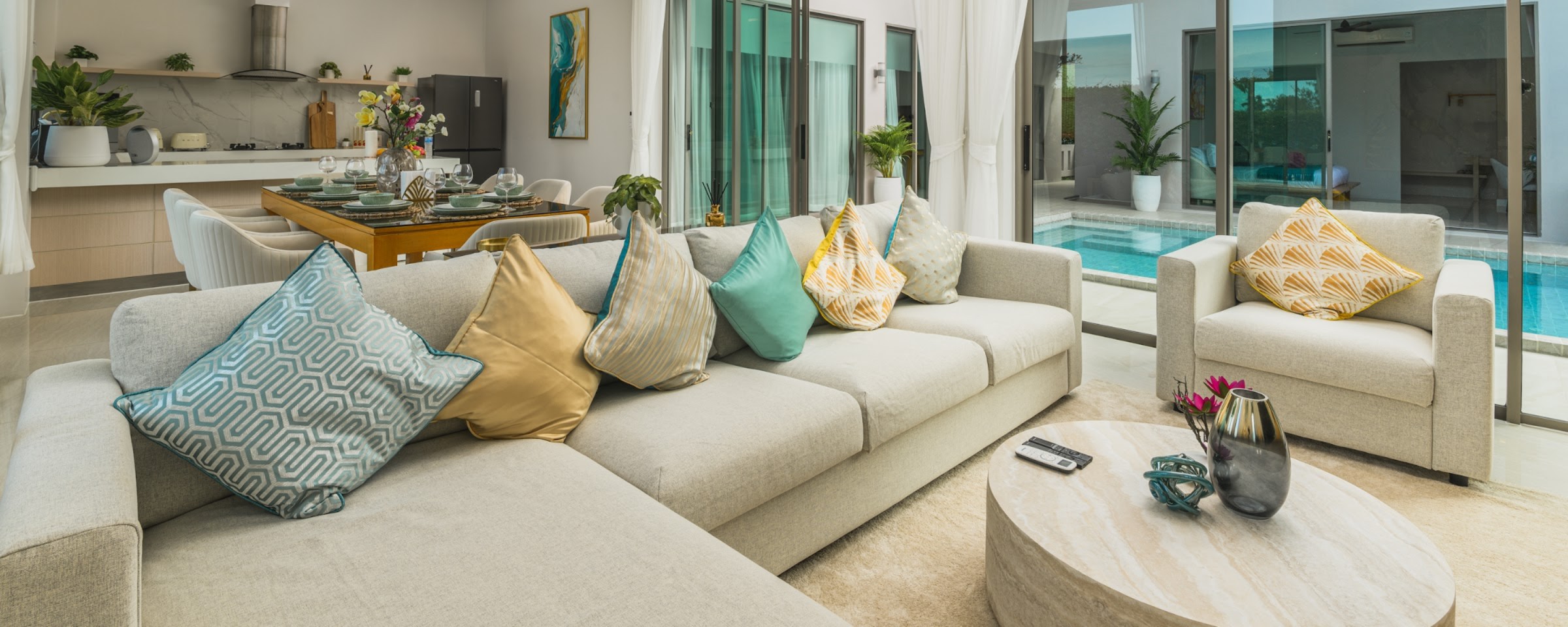

A luxury villa in Phuket can age five years in eighteen months. It can also look immaculate after five years. Same building, same climate, same guest volume. The variable that decides which version exists is invisible to the owner for the first six to twelve months, and largely irreversible by the time it becomes obvious.
We see the first version regularly. An owner opens the door for the first proper inspection in months and finds worn fabrics, dulled surfaces, mildew where there should be none, pool tiles that have not been brushed properly since launch. The reviews are still respectable. The bookings are still arriving. There was no warning, because nothing in a monthly statement measures condition.
Why the decline stays invisible
Preventive maintenance in a tropical climate is unglamorous, continuous, and produces no visible result on the day it is done. That is precisely why it is the first thing to disappear when nobody is holding the standard. Salt air, humidity above eighty per cent for months at a time, ultraviolet load, and a monsoon that finds every unsealed joint. None of it announces itself. All of it compounds.
The work that prevents it is a calendar, not a reaction. When it sits on a calendar, an owner never hears about it. When it is reactive, the owner hears about it as a bill.
A villa behaves like a plant, and there is a reason for that
Owners say it and it sounds sentimental. It is not. A house is not an object sitting still, it is a set of systems that are either running or not running, and every one of them degrades faster when it stops.
Air conditioning does two jobs, temperature and moisture. Stop it in a humid climate and the second job stops with it. Building science has measured what follows: in a well-sealed house, air leakage alone carries fifteen to twenty pounds of water a day into an unconditioned interior when outdoor dew points sit in the seventies Fahrenheit. Phuket sits there for months at a time. That water has to go somewhere, and it goes into fabric, timber, plaster and grout.
The rest follows the same logic.
- Water traps dry out in an unused bathroom, and the smell that returns is drainage, not neglect of cleaning.
- Pumps, valves and compressor seals seize or dry from disuse. Mechanical parts last longer being used gently than sitting still.
- Pool chemistry drifts within days without circulation, and algae is a matter of days rather than weeks.
- Pests colonise quiet buildings. An occupied house is disturbed daily. An empty one is not.
- Nobody notices any of it, because there is nobody there to notice.
The industry that carries this risk does not debate it. Vacant and unoccupied property cover generally costs more than cover on a lived-in house, and often narrows what it will pay for, because insurers hold the claims data on what happens to buildings nobody is standing in.
Insurers do not argue about this. They price it, because they hold the claims data on houses nobody walks through.
An empty house does not rest. It dries out, it seizes up, and it starts to smell of its own drains.
A villa that is aired, run, used and looked at weekly is a villa whose systems are being exercised and whose small failures are caught while they are still small. That is the entire difference between a house that looks immaculate after five years and one that aged five years in eighteen months.
What gets skipped first, and in what order
In every underserved property we have assessed, the same items are missing in the same sequence.
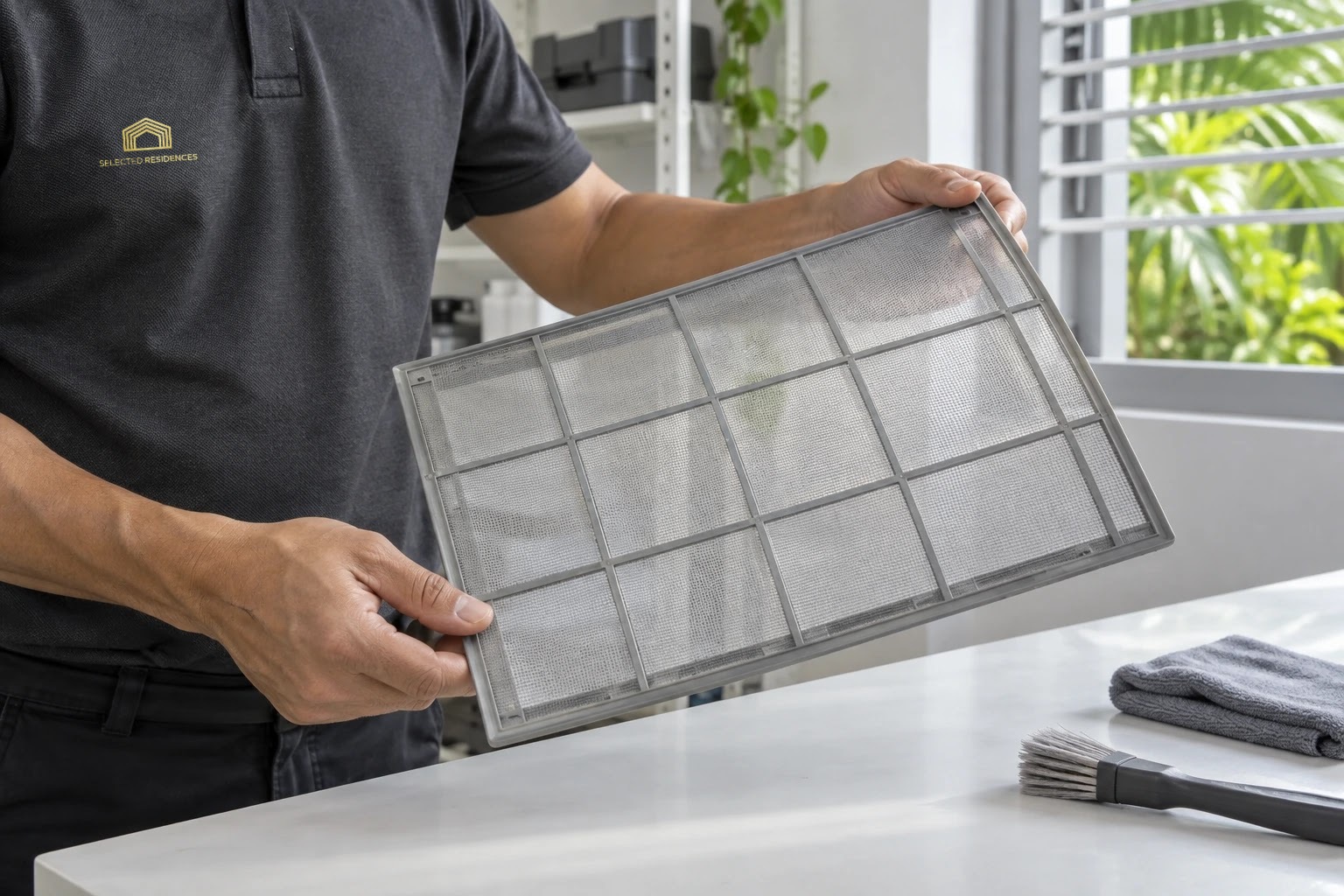
- Deep cleaning beyond turnover. A turnover clean is three to four hours. Deep cleaning is a different job: oven interiors, behind appliances, air conditioning filter washes, pool grouting, tile sealing, fabric protection. It costs real money and shows no immediate result, so it goes first.
- Scheduled supplier coordination. Plumbing, electrical, air conditioning service, pool chemistry, pest control. A competent operator runs these on dates. Run reactively instead, each one costs several times more and arrives during a guest stay.
- Staging refreshes. Throws, art, table settings, photography. A villa that looked current two years ago reads as tired now, and nothing about that is visible from inside the house.
- Inventory rotation. Linen, towels, glassware, robes, kitchen tools. Without a monthly count, thinning towels reach a guest before they reach anyone else, and that guest writes the review.
- Owner reporting. A bank transfer is not a report. Occupancy by source, rate achieved, review summary, benchmarking and a capital expenditure flag list take skilled hours to produce, which is why they vanish quietly.
Month six, month eighteen, month thirty-six
The pattern is consistent enough to set out as a timeline. Nothing in it is dramatic on any single day, which is the whole problem.
How the decline actually arrives
Month six, month eighteen, month thirty-six
What the owner sees, and what is happening underneath it.
MONTH SIX
The villa looks fine and the reviews hold
Filters are not being deep cleaned. Pool grouting is starting to discolour. The extractor is accumulating grease. Two or three soft furnishings have quietly been swapped for cheaper substitutes after laundry damage. The listing photography is going stale.
MONTH EIGHTEEN
Ratings drift by a decimal and search position softens
The decimal matters far more than it looks. Placements are lost at the margin, visibility falls, and the owner reads the revenue dip as a slow market rather than as a condition problem.
MONTH THIRTY-SIX
The first capital expense lands
Rotted timber under a deck nobody sealed. A pool replumb after two years of drifting chemistry. Air conditioning units destroyed by filter neglect. One line item erases the whole of the notional saving.
Our own observation across managed and previously self managed properties on this island, not a cited figure. The pattern is consistent enough that we now treat month six as the point of intervention rather than month eighteen.
Nobody photographs the inside of an oven. It is still the first thing a chef opens.
Two villas a kilometre apart are not in the same climate
There is a standard for this, and it is worth knowing about because it explains why two owners on the same island get completely different maintenance bills. ISO 9223:2012 classifies how aggressively an environment corrodes metal, on a scale that runs from C1, a heated indoor room where almost nothing happens, up to CX, the extreme category reserved for offshore and coastal sites exposed to frequent salt spray. Coastal locations sit across C3, C4 and C5, and the thing that moves a property up that scale is airborne salinity.
Airborne salt does not spread evenly. It depends on distance from the water, the prevailing wind, whether there is a ridge or planting between the house and the sea, and how often the property is washed by rain rather than coated by spray. A villa on an exposed southwest headland and a villa a kilometre inland behind a hill are, in the only sense that matters to the building, in two different climates.
That is not an abstraction. It decides the service interval on every part of the house that is made of metal or depends on metal:
- Door and window hinges, sliding door rails, locks and handles
- Outdoor kitchens, barbecues, sinks, taps and drainage fittings
- Light fittings, screws, brackets and balustrade fixings
- Pool hardware: ladders, handrails, pump housings, skimmer plates
- Air conditioning condenser coils and outdoor unit casings
None of these fail dramatically. They seize, they stain, they lose their finish, they stop closing cleanly, and then they get replaced. On an exposed site that cycle runs visibly faster than it does inland, and a maintenance plan written without reference to the site is simply going to be wrong in one direction or the other.
Salt air does not wear a house down evenly. It starts at the hinges, the rails and the locks, and within a kilometre of the water it starts early.
It is a fair question to put to any operator. Where does this property sit on that scale, and what in your schedule changes because of it? An operator who has thought about the building has an answer. An operator running one generic checklist across every villa has not been asked before.
Wear follows arrivals, not nights
Owners track occupancy because that is the number on the statement. The house responds to something else entirely. It responds to arrivals.
The average stay in this market is around five nights. At high occupancy that puts a villa through roughly fifty to sixty full handovers a year. Each one is a complete cycle: strip and remake every bed, launder everything, reset the kitchen, deep clean the bathrooms, reconcile the inventory, test the systems, walk the house before the next guest opens the door.
That is where the wear actually lives. Linen and towels lose their life to wash cycles, not to guest-nights. Door furniture, drawer runners, taps and appliances wear on use. The pool takes its heaviest chemical load in the first days of a new group. Every handover is also a moment when something small can be missed, and a missed handover is what a review is usually describing.
Which produces two villas with identical annual occupancy and completely different condition. Sixty short stays and twelve month-long stays can fill the same calendar. One of them is fifty-plus handovers of accumulated wear. The other is twelve, and the difference compounds every year.
Sixty guests and sixty nights are not the same year. Only one of them wears out the sofa.
This is the practical reason we plan inventory, linen rotation and deep-clean intervals against handover count rather than against a generic annual schedule, and the reason a season of short high-value bookings is budgeted differently from a season of longer ones. It is the same revenue on the statement. It is not the same year for the building.
The Phuket calendar decides the work
Preservation here is not a generic maintenance plan. It is shaped by two seasons that behave completely differently, and an operator who does not schedule around them is simply reacting twice a year.
The southwest monsoon runs roughly May to October. That is when water finds every failure: unsealed timber, tired silicone, blocked drainage, roof flashing, garden run-off. It is also the low season, which makes it the only sensible window for anything invasive. Refinishing, resealing, replumbing, repainting, tree work and deep planting belong here, when the calendar has gaps and a week of disruption costs almost nothing in revenue.
The dry high season runs roughly November to April, when the house is full and the rate is at its highest. Nothing invasive should be scheduled into it. What belongs here is inspection and protection: filters, chemistry, fabric care, touch-ups between stays, and the checks that catch a small failure before a full villa notices it.
- April, before the rains. Seal timber, check every silicone joint, clear drainage and gutters, service air conditioning before it runs hard.
- May to October, the working window. Refinishing, deep cleans, capital projects, pool surface work, garden reset, anything that needs the house empty.
- October, before the season. Full readiness check, photography refresh if the staging has moved, inventory count, systems tested under load rather than at rest.
- November to April, in season. Inspection and protection only, on a schedule the guest never sees.
An owner can test any operator against that calendar with one question: what did you do in September, and what will you do in April? A manager has two different answers. A bookkeeper has the same answer twice.
Three questions that separate a manager from a bookkeeper
Preservation cannot be tested in advance, because the failure mode stays invisible for months. It can be interviewed for. Three questions filter out the worst cases reliably, and they work on us as well as on anyone else.
- What is the annual deep-cleaning schedule for this villa? A real operator answers with dates, items and vendors. A bookkeeper answers in adjectives or changes the subject.
- What capital expenses do you plan for in years two and three? A real operator has a list with intervals attached: air conditioning service, refinishing, fabric replacement. A bookkeeper has not considered the question.
- Show me a sample monthly owner report. A real operator has one to hand. If none exists, none has ever been produced.
Detailed answers mean you have a manager. Vague answers mean you have a bookkeeper, and the villa pays the difference in years two and three.

What we do about it
Every property in the portfolio scored above 92 percent on a twenty-three point audit before it was taken on. A house that cannot reach that standard inside the model is declined rather than onboarded and hoped for. Every villa is visited weekly. Deep cleaning, seasonal readiness checks, quality control inspections and pest control sit on a schedule rather than in a request queue, and the owner receives the record.
We are not in the show business. We are in the business of what the house is worth in five years, which is a different job and a more expensive one, and the reason we would rather decline a property than spread the standard thinner across more of them.
If you suspect this is already happening
If you are an owner who suspects the pattern above is running in your property, send your listing and the last six months of owner reports, if any exist, to contact@selectedresidences.com. We will come back with a written assessment of where preservation work is and is not happening, at no cost. If the property clears our audit and the current arrangement is failing it, we may be able to take it on. If it does not clear, we will tell you what to fix and recommend you stay where you are until it does.