
Neighbourhood guides for Phuket read like restaurant lists. The three things that actually decide whether an address works are which way it faces in the monsoon, whether anything is open in September, and how long it takes to get to the airport at six in the evening.
Chosen properly, not by the brochure
The corridor, coast by coast
Three things decide a Phuket address: monsoon exposure, whether the services stay open in September, and how far you are from the airport.
Bang Tao & Cherngtalay
West coast · Thalang
The only stretch of the west coast with a genuine year round services cluster. Supermarkets, clinics, schools and restaurants that stay open through the monsoon. This is why it holds value while purely seasonal beaches do not.
Layan & Nai Thon
West coast · north
Quiet, low density and bordered by protected national park coastline that cannot be built on. The most reliable scarcity argument on the island, because it is statutory rather than commercial.
Surin & Kamala
West coast · central
Established, prestigious and steeper, with strong views and a smaller flat footprint. Kamala keeps more of a resident community through low season than Surin does.
Kata, Karon, Patong
West coast · south
Highest footfall, highest density, and the shortest walk to everything. The part of the island the guest of a private villa is usually trying to avoid, and the part with the best rental liquidity at lower price points.
Rawai, Nai Harn, Cape Panwa
South and south east
The monsoon proof side. Usable water when the west coast is closed out, the shortest crossings to Ko Hae and the Racha group, and a genuine year round resident community rather than a season.
Koh Kaew, Ao Po, the east
East coast
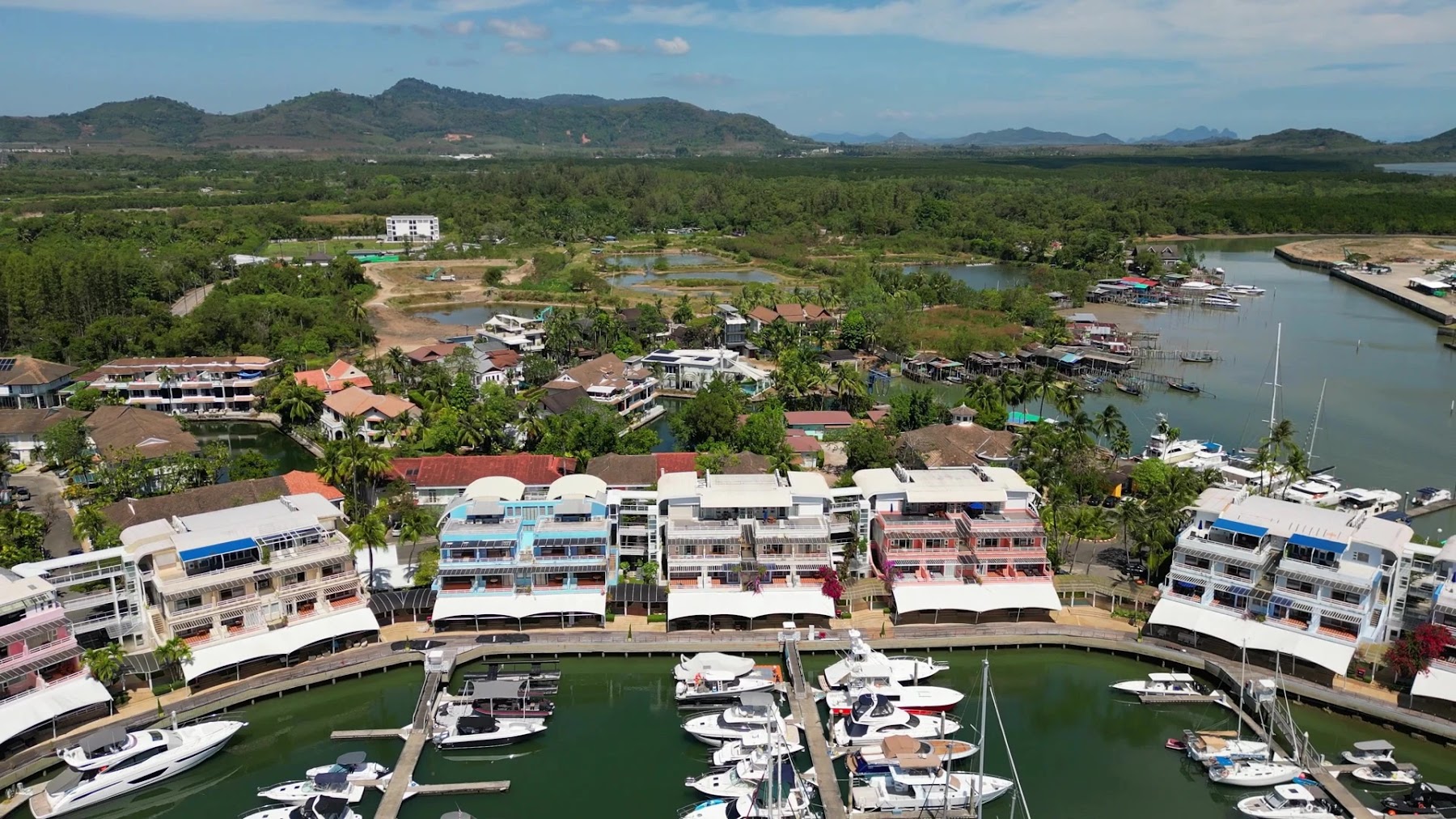
Where all four marinas are. Calm water, island and mangrove views rather than open horizon, and the only side of the island where a boat can sit through a monsoon.
Monsoon exposure, low season service levels and community character are our own operating observations across these areas, not cited figures. Airport proximity is relative and stated qualitatively on purpose, because journey times on this island depend far more on the hour than on the distance.
Bang Tao and Cherngtalay: the only year round cluster on the west coast
This corridor holds its value for a reason that has nothing to do with the beach. It is the one stretch of the west coast with a genuine year round services base: supermarkets, clinics, international schools, and restaurants and retail that keep trading through the southwest monsoon.
That is what separates living somewhere from holidaying somewhere. A beach that is spectacular in February and shuttered in September is a holiday address. An area where the supermarket, the school and the clinic are open in both months is a place people can actually base a life, and the rental market reflects that in low season when everything else empties.
Cherngtalay is valuable because the supermarket is open in September. Everything else about it is secondary.
Layan and Nai Thon: scarcity that is written into law
Immediately north of Layan the coast enters Sirinat National Park, established on 13 July 1981 as Nai Yang National Park and renamed Sirinat in 1992. It covers 90 square kilometres, of which 68 are marine and 22 are land, and it protects the beaches of Nai Thon, Nai Yang, Mai Khao and Sai Kaeo, Mai Khao being the longest beach on the island.
This matters commercially in a way that no road project does. Almost every scarcity argument in Phuket property is a commercial one: a developer says land is running out, and land is not running out. Statutory protection is different. Protected coastline does not get released when prices rise.
So the case for Layan and Nai Thon is not a forecast. It is that the quiet immediately to the north of them is permanent, and there are very few places on this island where that can be said.
And the price of development, measured
The same park record carries a fact worth printing next to every masterplan. Mai Khao and Nai Yang are sea turtle nesting beaches, with turtles arriving between November and February. Leatherback nesting on those beaches has ceased since 2013, attributed to coastal development pressure.
We are not going to pretend that is an argument against the island. It is an argument for building carefully on it, and for treating the protected sections as the asset they are rather than as land awaiting a change of designation.
The south, which is where the year actually works
Rawai, Nai Harn and the Cape Panwa side are the parts of Phuket most often dismissed in a neighbourhood guide because the beaches are not the postcard. They are also the only parts of the island with usable water in the monsoon months, the shortest crossings to Ko Hae and the Racha group, and a genuine resident community that does not evaporate in May.
For an owner planning to be here in low season, or for a guest whose week falls between May and October, the south is frequently the right answer and is almost never the one presented.
The postcard beaches close for five months. The unfashionable ones do not. Pick according to the months you will actually be here.
Phuket Town, and the eighteen reasons to go there
Old Town is not where anyone on this list lives, and it is where the island’s food actually is. Of Phuket’s sixty entries in the Michelin Guide Thailand 2026 edition, eighteen are Bib Gourmands, and that list runs heavily through the shophouses, stalls and small kitchens of the town rather than the resort strip.
Thirty minutes from most of the west coast, and a completely different island. Any address on this list should be judged partly on how easily it reaches it.
The two months test
If you take one thing from this page, take this. Spend a month here in February and a month here in September before committing to an address. They are two different places. February is the island in the brochure. September is the island you will actually own.
Almost every regret we hear from owners on this island traces back to a purchase made after one visit, in high season, on the west coast.
What we tell people
Choose the coast before the house. Work out how many of your days here will fall between May and October, and let that decide the side of the island rather than the view. Check what is open in low season within a ten minute drive. Ask which way the terrace faces and at what hour the sun leaves it. And drive the route to the airport at the time of day you would actually do it.
Every one of those is dull, checkable and free. Together they account for most of the difference between owners who are still delighted in year five and owners who are quietly trying to sell.
Sources. Sirinat National Park established 13 July 1981 as Nai Yang National Park and renamed Sirinat in 1992, covering 90 square kilometres of which 68 are marine and 22 are land, protecting Hat Nai Thon, Hat Nai Yang, Hat Mai Khao and Hat Sai Kaeo, with Mai Khao the longest beach on the island, sea turtle nesting between November and February, approximately 2 square kilometres of beach forest and 1 square kilometre of mangrove, reefs 700 to 1,000 metres offshore, and leatherback nesting ceasing since 2013 attributed to coastal development: public park record, read 24 September 2026. Phuket’s sixty entries in the Michelin Guide Thailand 2026 edition including eighteen Bib Gourmands: Michelin Guide Thailand 2026 as compiled for Phuket, read 24 September 2026.