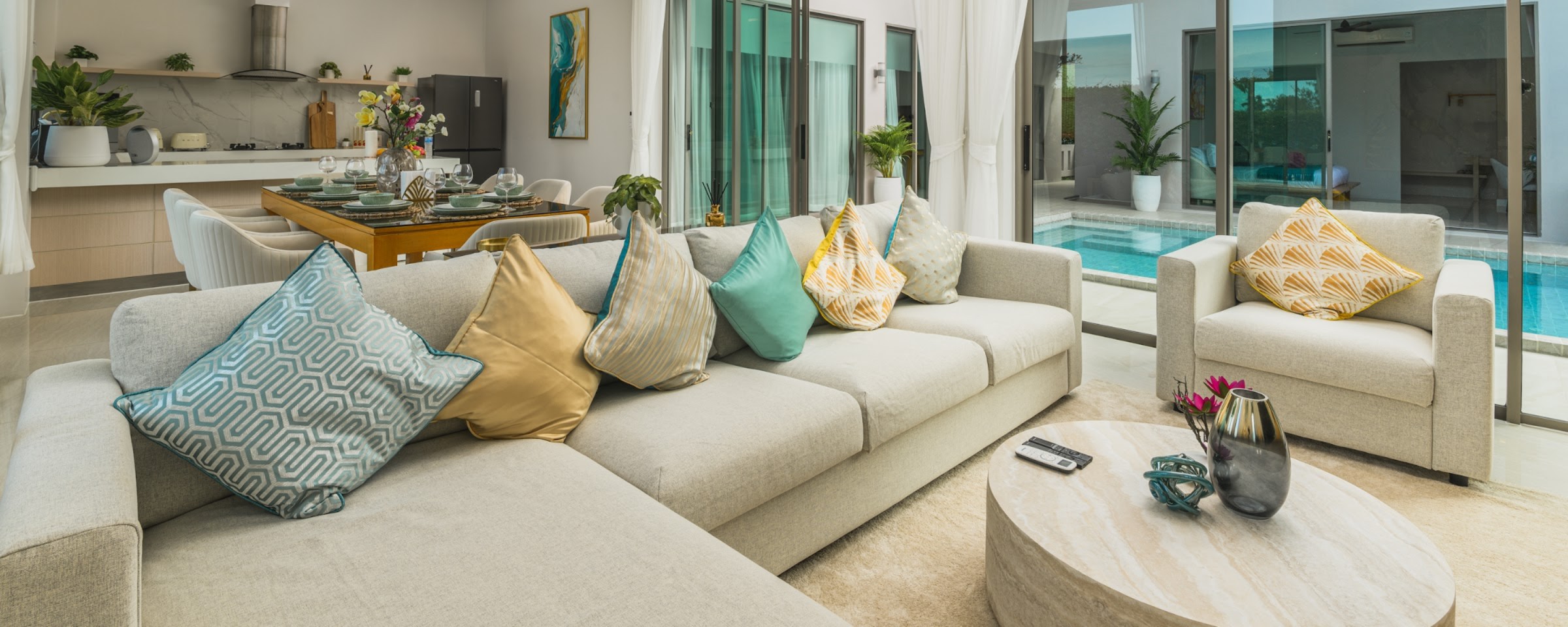

Most owners arrive at the question the same way. A twelve month tenancy is offered, the figure is reasonable, the calendar goes quiet, and the decision feels made. It is worth slowing down at that moment, because the three terms available in Phuket are not three prices for the same thing. They are three different relationships with the house.
The twelve month lease that becomes four years
A long tenancy rarely stays twelve months. It renews, and then renews again. Across the tenancies we have seen on this island the same occupant stays about four years before moving on, and six is not unusual. That is the part owners underestimate, because nothing about the first signature suggests it.
There is a structural reason the paperwork never shows this. Under Thai law a lease only has to be registered at the Land Department once it runs beyond three years, and registration means fees, disclosure and a trip neither party wants. So residential leases in Phuket are written at twelve months and renewed, again and again, and a tenancy that lasts five years exists as five separate one year documents. The length is real. It is simply never written down in one place.
What comes back at the end of it is usually a tired house. Not damaged, not abused, simply lived in without anyone holding the standard. Sealant that was never redone. Teak that went grey two dry seasons ago. A compressor nobody serviced because nobody was asked to. Grout, hinges, filters, lamp shades, the pool surface. None of it is dramatic on its own. Together, over four years, it is a renovation.
The commercial consequence is felt later, at the moment it costs the most. A tired villa is very hard to sell, because a buyer cannot picture themselves in it. A viewing works when the house is presentable, when the light is right, when a buyer walks in and sees their own life there. That is not a matter of staging tricks. It is the accumulated result of years of small standards kept, or years of small standards let go.
A tenant signs for twelve months. The house signs for as long as they stay.
Why a lived-in house ages differently
It is worth being precise about the mechanism, because owners assume a single long-term occupant is gentler on a property than sixty different guests. On the surfaces, that is true. On the building, it is not, and the reason is that the two arrangements fail in opposite directions.
A house in rotation is inspected constantly. Somebody walks it between every stay, and the small things get caught while they are still small: the joint that has started weeping, the filter loading up, the discolouration at the base of a wall that means water is finding a path. A house with a long-term occupant is walked by nobody whose job is the building. The occupant reports what inconveniences them. They do not report what is quietly costing the owner money, because they cannot see it either.
That gap is where four years of small failures accumulate. Nothing about it is the tenant’s fault. They were never given the job.
A long tenancy does not damage a villa. It removes the last person who was looking at it closely, and four years is long enough for that to show on the walls.
What predictable revenue actually buys
The honest case for long term is real, and we make it plainly: the income is predictable, the operating effort is close to zero, there is no marketing cost, no turnover, no seasonality to manage. For an owner who lives elsewhere, has no intention of using the house, and wants one transfer a month with nothing else attached, long term is a defensible answer.
It comes with conditions that are easy to accept and easy to forget:
- The house becomes someone’s home. You lose access to it, including for your own stays.
- Upkeep happens at the occupant’s standard, not yours, unless it is contracted and supervised.
- You will not know the real condition of the property until it is handed back.
- A long tenancy in place narrows your buyer pool, since most buyers of a villa at this level want vacant possession.
Long term also changes how you would furnish. An unfurnished or lightly furnished house is a rational long term product, and in that direction the furniture budget is money you do not need to spend. The reverse is the important part. A villa that is already furnished, already photographed, already has a character of its own, is not a long term product. Putting it there wastes the very thing that makes it valuable.
Midterm, the category we prefer
Between the two sits the term we like most, and the one almost nobody in Phuket operates properly. Midterm is one to three months. It exists because of a guest who did not exist at this scale five years ago.
These are senior software engineers, founders, consultants, specialist medical and technical professionals, people on a defined mission with a start date and an end date. They are not tourists and they are not tenants. They arrive with work to do, they want a house that functions on the first morning, and they leave when the mission ends.
For an owner, midterm resolves the tension that long term and short term each create:
- Revenue sits between the two, closer to short term than most owners expect, with a fraction of the turnover.
- Bookings are long enough to be stable and short enough that the calendar stays yours.
- Marketing cost per booked night is far lower than short term, because one enquiry fills eight to twelve weeks.
- The house stays in rotation, which means it stays inspected, serviced and photographable.
That last point is the one owners feel years later. A villa in midterm rotation is maintained continuously by people whose job it is, and it is ready to show to a buyer on any given week without a three month rescue project first.
How we select a midterm guest
A three month stay is a small tenancy, and it is chosen rather than accepted. We do not take midterm bookings off an open listing and hope for the best. The demand reaches us through relationships we have spent years building on the island and we do not publish that list, for the same reason no operator publishes its best suppliers. What the owner needs to know is what happens to an enquiry once it arrives.
- Every midterm enquiry is qualified in conversation before a rate is discussed. We establish the purpose of the stay, the employer or the work, the number of occupants and the exact dates.
- Identity and, where relevant, employment are verified. No midterm booking is confirmed on a platform profile alone.
- We match the guest to the house rather than the reverse. A single professional working from home needs a quiet wing and a desk with real light. A relocating family needs a kitchen that works and a garden that does not require a gardener standing in it daily.
- House standards are agreed in writing at the outset, including the cleaning cadence, pool and garden service, and what happens if something breaks at nine on a Sunday.
- A property manager inspects at handover, mid stay and at departure, and the owner receives the record.
The result of that filter is the part owners feel. A three month guest who was selected behaves like a resident who knows they are a guest, and the house comes out of the stay in the condition it went in.
Short term, the higher ceiling and its cost
Short term produces the strongest revenue per night, and it is where a beautiful house earns what it is worth. It is also the most expensive term to run, and the cost is not only operational.
Distribution has a price. Visibility on the platforms is paid for in commission, in photography, in content, in pricing work that never stops, and in a review position that takes years to build and one bad month to dent. Turnover has a price too, in linen, restocking, housekeeping hours and the pre-arrival inspection that makes the difference between a five and a four.
Run properly, that cost is worth carrying, because the ceiling is higher and the house is seen and serviced constantly. Run casually, short term is the term that loses money fastest.
Where a villa actually belongs
Three strategies, side by side
What each one actually costs you
Not a ranking. Three different products, with three different things given up.
Long term
Midterm
The category we prefer
Short term
Our own comparison, drawn from managing all three models on this island. Note the row almost nobody weighs: condition over time. A house let on a twelve month lease declines quietly, because nobody inspects it between tenants.
Which gives a straightforward rule. If the house is empty, plain and you have no intention of ever using it or selling it presentable, long term is a rational choice and we will tell you so. If the house is furnished and has a soul, it belongs in midterm and short term, and the right answer is usually both, sequenced across the year rather than chosen once.
How we actually build the year
We do not treat the three terms as a menu. We look at the house, the season, your own use of it and what you intend to do with the asset in five years, then we build the year around that. Some of our properties run short term in high season and one long midterm mission through the quiet months. That is not a compromise. It is the only version where the revenue and the condition of the house both hold.
If you are weighing a twelve month offer against the alternative, the question worth asking is not which pays more this year. It is which house you would rather be standing in when you decide to sell.
Send a short description of the villa, its location and your current arrangement to contact@selectedresidences.com and we will come back with a view on which term the property belongs in, including the recommendation that you keep the tenancy you have if we would not improve your position.